Petrography (microscopic analysis) of concrete can reveal
defects in its composition and in the way it was placed. Concrete
contains aggregate grains that are a subequal mixture of limestone,
granitics, and argillaceous (low-grade metasedimentary) fragments. It
also contains entrained air bubbles that can be counted.
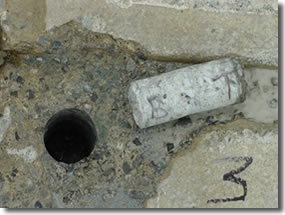
Concrete core from a sidewalk that had been improperly cured at subzero
temperatures
|
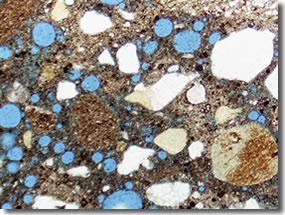
A microscopic view of polished concrete often reveals problems in its
makeup and placement
|
There are three major groups of aggregate grain types: crystalline
(mostly granitics with related coarse-grained minerals such as quartz,
potassium feldspar, and plagioclase feldspar); carbonate (skeletal
limestones and some recrystallized dolomites); and metasedimentary
(mostly low-grade slates and argillites, clay-rich, in some cases silty
or sandy). Carbonate grains tend to be rather large (gravel-sized),
while most quartz and feldspar grains are of fine to medium sand size
(100-500 microns). A number of heavy minerals (primarily garnet and
amphibole) are present as part of the crystalline rock population; a
few large chert grains (silicified skeletal limestones) were noted as
well.